マシンビジョンテクノロジー
Optical path design technology

The optical path design technology is mainly aimed at measuring parts with special materials, 複雑な機能, そして小さな寸法. 従来の光源のイメージ効果や構造空間が測定要件を満たせない場合, 光の特性と測定要件に基づいて深く分析および評価できます, 特殊な光路構造設計を実施, 高品質の画像効果を得る, 精度の高い測定を実現します.
2D image stitching technology
2D image stitching technology is mainly aimed at product measurement in large field of view and high-precision scenes. By collecting multiple high-resolution images of different parts of the product, common feature points are extracted from each image, and an affine transformation matrix is constructed; Merge multiple images into a seamless, high-definition image through matrix operations. Unlike traditional region based stitching, this technology combines image preprocessing, registration, fusion, and boundary smoothing techniques to achieve high-precision stitching based on image features.
3D image spatial stitching technology
The 3D image spatial stitching technology is mainly aimed at measuring the dimensions of 3D space. Through 3D matrix transformation, multiple 3D point clouds are affined to the same spatial coordinate system to form a full angle 3D model. The company has designed a high-precision calibration board for multi face stitching images, which combines image preprocessing, feature point localization, affine, and image fusion technologies to achieve high-precision stitching.
2D and 3D coordinate system conversion technology

1. Simultaneously extracting features of the same object in both two-dimensional and three-dimensional space, using techniques such as rotation, scaling, and projection to obtain the matching relationship between two-dimensional and three-dimensional features, and thus calculating the transformation matrix between spatial and planar coordinate systems.
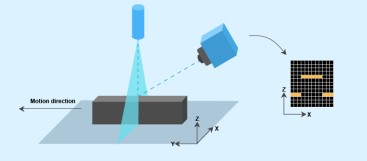
2. By combining line laser and planar camera, the technology of capturing corner features through laser 3D imaging and capturing peripheral features of the plane through planar camera is integrated. The conversion matrix between 3D and 2D coordinate systems is obtained through calibration, and the features in the 3D coordinate system are projected onto the 2D coordinate system.